
The Country Similarity Index attempts to quantify how similar countries are to each other relative to other countries. The index is a statistically-based way to measure this. 20% of the index is based on geography. 12.5% of a country’s geography score (2.5% of the overall Country Similarity Index score) is allocated for the country’s vegetation, including their natural wilderness and their agricultural areas. The following are the factors that were included:


Predominant Crops
Although countries may have the same percentage of farmland, many grow completely different crops. It has a lot to do with the climate and the agricultural traditions of the country. Wheat is the dominate crop from Northern Europe to Central Asia. Most rice is cultivated in the eastern part of Asia. Corn and soybean are typically grown more in both North and South America. Sub-Saharan Africa also tends to plant a lot of corn. In many countries around the Mediterranean, the dominant crop is olives. The Sahel region of Africa devoted most of its cropland to sorghum. Many tropical islands grow coconuts and sugarcane. Although Arabian countries do not have a lot of farmland, they predominately grow dates. Of course there is often a mix of different crops. For instance, in China, the percentage of land area used to grow corn, rice, and wheat is about equal.
The United Nations is the source of the data:
http://www.fao.org/faostat/en/#data/QC
Biome
Although plants in different regions may not be related to each other, they still might be part of the same type of biome. For instance, there are tropical rainforests in both Africa and South America, despite their plants not being closely related, the scenery these environments create plants that tend to look very similar, due to evolving in the same type of climate.
Oxfam and Biome Explorer are the main sources of the data:
https://www.oxfam.org.au/wp-content/uploads/2015/01/biomes-world-map-1b.jpg
http://www.terrestrial-biozones.net/Biomes/Biomes-Map.html
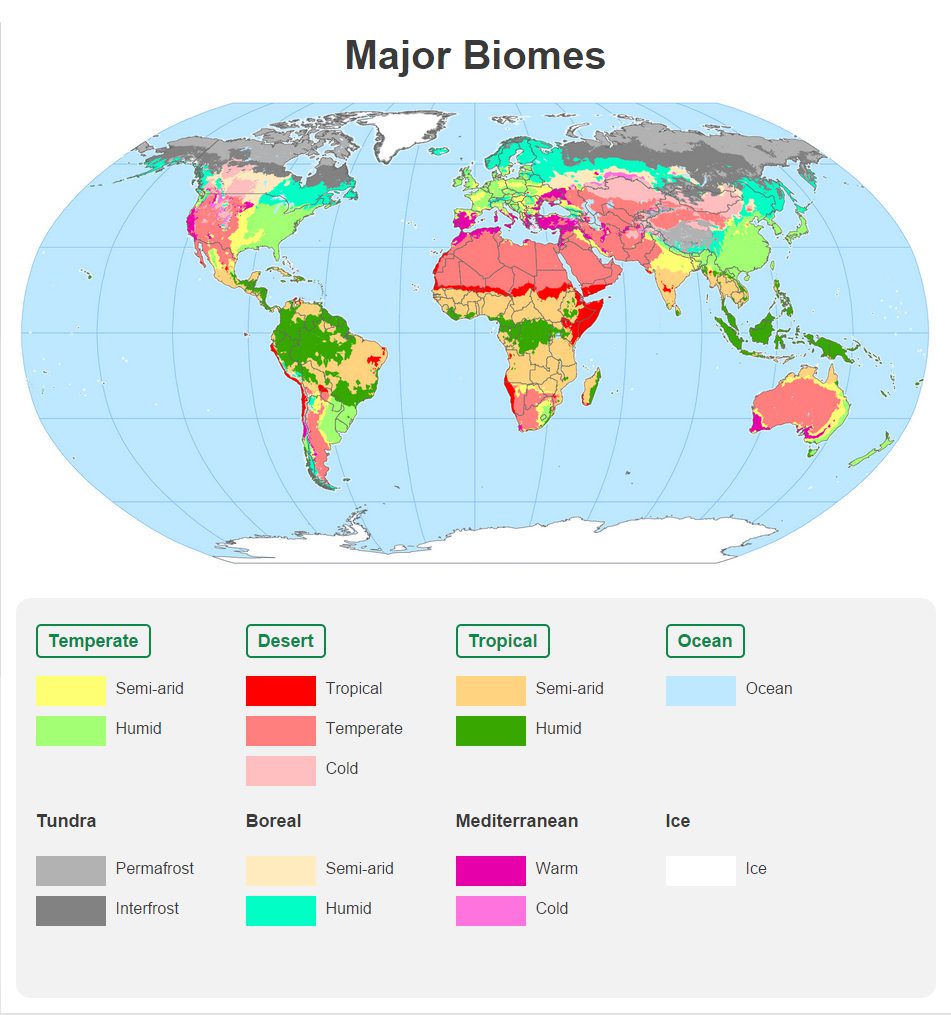
Countries were categorized into the following biomes:
Alpine, Taiga, Tundra, Tropical Rainforest, Tropical Seasonal Forest, Temperate Forest, Temperate Grassland, Temperate Desert, Tropical Desert, Desert Scrub, Chaparral
Floristic Region
A phytochorion is an area of the world where botanists have found plants having a similar evolutionary history. There are six main kingdoms. The largest one is the Holarctic kingdom, which includes most of the land in the Northern Hemisphere. Most of Latin America is in the Neotropic kingdom. The Paleotropic kingdom consists of Sub-Saharan Africa and South Asia. Australia also has its own unique kingdom. The two smallest kingdoms are the Antarctic kingdom, which includes Patagonia and New Zealand, and the Cape Kingdom, located only in country of South Africa. Each kingdom is also broken down into different floristic regions that have even more similar plant life. The largest floristic region is the Circumboreal Region, which consists of the majority of Canada, Europe, and Russia.
Wikipedia and Armen Takhtajan are the main sources of the data:
https://en.wikipedia.org/wiki/Phytochorion
https://www.researchgate.net/figure/Floristic-regions-of-the-world-from-Takhtajan-27-Region-names-and-associated_fig1_23446362
Calculation Method
The crops and native plants of two different countries are compared using the following method:
Example: In South Korea, 729814 hectares of rice are harvested annually, while soybeans are the second most hectares with just 58537, amounting to less than 10% of the total harvested land. Therefore, South Korea gets 1.0 points for rice and no points for soybeans. In Bhutan, 13146 hectares of corn are harvested, while 12261 hectares of rice are harvested, as well as 6319 hectares of nutmeg. Since rice amounts to 38% of the main crops harvested, Bhutan gets 0.4 points for rice. When the agriculture of South Korea and Bhutan is compared, they are credited for 0.4 out of 1.0 points. Like South Korea, Suriname is another country where the only predominant crop is rice, so it would also get 1.0 points. When the agriculture of South Korea and Suriname is compared, they are credited for 1.0 out of 1.0 points, a perfect match, despite being in completely different parts of the world.
1 Comment